Welcome to your Geography Model Exam Questions for Grade 12
The questions are from grade 9 & 10 lessons.
I. Choose the best answer for the following questions
1.
Which one of the following is the best to describe the absolute location of a place?
2.
The latitudinal limit of hot desert is:
3.
The most important mammals in equatorial rainforest are _______.
4.
Which continent has the largest rainforest of the world?
5.
Which of the following economic activity is dominant in hot desert areas?
6.
All of the following are the major relief groups of Ethiopia, except.
7.
The soil type commonly found in the equatorial rainforest is:
8.
The temperate regions are situated between ______ and _____
9.
The region with dry summer and rainy winter season is ______.
10.
Colorado deserts are found in:
11.
Which of the following orderings will represent a bottom up vertical distribution of climatic types in Ethiopia?
12.
The Lee ward side of mountain:
13.
In the equatorial rainforest region, rainfall is mainly __________
14.
Plantation agriculture is an economic activity which is predominantly found in the:
15.
A series links by which energy is passed from one organism to another is called _____.
16.
As contour is to altitude, isohyet is to:
17.
The major occupation of the Eskimo People is:
18.
As one moves north and south from the equator;
19.
Plantation agriculture is characterized by
20.
Which of the following naturally grow in the equatorial rainforest zones?
21.
The major characteristics of shifting cultivation is
22.
How many seasons are there in the temperate zone?
23.
The seasonal migration of men with their animals to the high mountains in summer and to the valleys in winter is known as ________.
24.
The world‟s leading producer of Cocao is:
25.
The lowers limit of “Wurch” is at about:
26.
Which one of the following desert is found in Africa?
27.
One of the following is not a factor of weather change in temperate zone?
28.
The largest producer of rubber in Africa is __________.
29.
Which one of the following statement is correct about the natural features of the tropical zone?
30.
What is the characteristic of the climate in the temperate region?
31.
Which sub-region is found in between coniferous forest belt and polar ice caps?
32.
According to the “Distance-time decay” concept, which one of the following is true?
33.
Of the following statements which one is correct about the temperate region?
34.
What does conservation mean? It is
35.
Xerophytes are largely found in __________ area.
36.
In the process of food chain, the one which is not a consumer is:
37.
Which of the following resources is Non-Renewable?
38.
Tundra vegetation is not found in
39.
Which one of the following measures of mortality and fertility is a good indicator of the level of development?
40.
Which of the following is not a social and economic characteristics of Ethiopia?
41.
Which one of the following measures indicate the total number of births occurring in a given year per 1000 population?
42.
The average number of children that would be born alive to a woman during her life time gives __________.
43.
Which one of the following is a socio-cultural factor in the dynamics of population change?
44.
The dramatic and alarming rate of population growth is called ________.
45.
The major areas of the world with high rate of population growth are characterized by;
46.
Which continent in the world has the smallest population size?
47.
Which of the following components of population change in Ethiopia has little effect on population size?
48.
If we assume that the current population of Ethiopia is about 90 million and its annual rate of 2.5% accordingly the population is expected to reach a size twice of it, it would be after ______.
49.
Which one of the following is a characteristic of the population of most developed countries?
50.
When one divides the total number of live births to all women of age group between 15 and 49 years and multiply it by 1000. It gives ________.
51.
If the reported live births in a country is estimated at 50,000 and the number of women of reproductive age is 1,000,000. what is the general fertility rate of the country?
52.
Which one of the following demographic factors is different from the others?
53.
The actual reproductive performance of a given population is called _________.
54.
Ethiopia has one of the largest non-productive populations in the world. This is a direct result of the country’s __________.
55.
The birth rate and death rate of a given country is 52/1000 and 32/1000 respectively, what is the rate of natural increase?
56.
The number of immigrants minus the number of emigrants divided by total population gives ________.
57.
What is the main reason for the population of most poor countries to have low life expectancy?
58.
What is the focus area of demography?
59.
Which one of the following is a push factor for migration?
60.
Which demographic variable may not make difference in population change and growth
61.
Suppose the number of emigrants and immigrants of country „X‟ are 40,000 and 250,000 respectively. If the total population is 105,000,000, what is the net migration rate for country „X‟?
62.
Related to the major components of population change, which one of the following is nonbiological factor?
63.
Which of the following factors of population change can have positive effect on the population growth
64.
Which of the following factors does not causes high fertility?
65.
Which factor of population change can have negative effect on population growth?
66.
The most populous country in the world is __________.
67.
The Ethiopian population has a shorter doubling period. One of the following could best explain this feature;
68.
Rapid rural population growth in Ethiopia has little contribution to:-
69.
Which one of the following demographic factors has a leading impact on the doubling time of population?
70.
What is the most possible demographic implication of high proportion of young age population?
71.
Which of the following can result in the decline of the total fertility rate of the population of a country like Ethiopia?
72.
The high rate of maternal mortality in Ethiopia is the result of:-
73.
A total of 400,000 babies were born in a certain region in 2012. of these new born, 340,000 babies survived in their first year of life, calculate the infant mortality rate of this region.
Questions 76-80 refer to the demographic data of a hypothetical region given in the table below
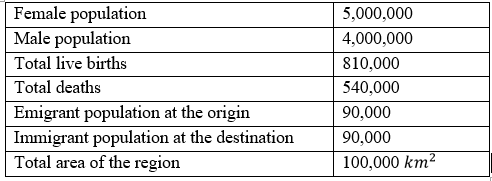
74.
What is the crude death rate of the region?
75.
Emigration rate of the region is
76.
What is the sex ratio of the region?
77.
The corresponding crude density of the region is
78.
The population growth rate of the region is